Wednesday, December 18, 2013
Why I Write...
I have written because the writing has been assigned. Research topics, essays, formal lab write ups, and paragraph responses have been the majority of my high school career. I have written because that is what gets me the A and the good GPA. I never used to write for fun because I belived it to be a waste of time. I have written because school makes writing a priority.
After taking this class, writing has become less of a pain for me. I found myself spilling out my frustrations, my worries, and my beliefs in my writer's notebook. I wrote to organize my thoughts and to voice my opinions. I wrote about my passions and my interests in the assignments that I was assigned. I was able to personalize my work, which is different than any other factual class. And I actually began enjoying it by the end of this semester!
Who knows what my future will bring me. Maybe I will continue writing for the amusement of it. Maybe I will write because this class has trained me to become a better writer. Maybe when I get to college and the teacher assigns an essay, I will write without any animosity. But I know one things for sure, I will write because I have been made new-- shaped by the teachings from this last semester of high school.
So thank you, Mrs. James! Even though I am not majoring in English or wanting to become a best-selling author, you have managed to shift my thoughts on the importance of writing. And this is a pretty big feat. I wish you the best of luck on the rest of your teaching career and hope you inspire many more students for years to come.

Thursday, December 12, 2013
Reading Response 7 Article
This article about Dave Barry's thoughts on College was quite humorous. I got a good kick out of reading it and found his biased thoughts to be very entertaining. Of course, it is improbable for everyone to only major in English, Sociology, Psychology, and Philosophy because math and science are simply "a waste of time". It is important that our world has a wide and even spread of different majors because if everyone did the same thing there would be no diversity. To me, it is important to have mathematicians, chemists, and scientists along with psychologists and philosophers. All majors serve a purpose in college and it is up to us to make the most of our decisions in life.
Wednesday, November 20, 2013
Reading Response #6: Allegiant (SPOILER ALERT)
As I approach the end of the book, I find myself very frustrated and upset. There's only a couple more chapters left but I could not continue because it made me so mad. Maybe that was the reaction Veronica Roth was trying to get out of her audience or maybe I'm overreacting, but I was really hoping for a better ending.
In the midst of all the chaos, Tris must make a final decision to sacrafice her life for her brother that betrayed her. Even though she has experienced many near-death tragedies, this situation is different because Tris acts out of love rather than revenge. The Abnegation side of her shows through as she chooses the selfless path and walks into the light of death. Miraculously, Tris survives the unstoppable death serum but as she is completing her mission of releasing a memory serum, she dies from the gun shots of the leader of the outside world. Tris is able to be reunited with her dead parents, but leaves all her friends and loved ones behind. It is so sad and depressing because I wanted to Tris and Tobias to be able to live happily ever after. Plus, Roth just kiled off the main character of the story! The rest of the book continues on with Tobias' point of view and he is able to reconnect with his mother who had abandoned him early in his childhood.
The ending kind of ruined the whole series for me now because all I can think is that Tris is going to die, no matter how noble her actions were. The books ending reminds me of other tragic love stories such as Romeo and Juliet. When Tobias comes back to find the love of his life no longer breathing, he was in broken. He says, "I squeeze Tris's hand, praying that if I do it hard enough, I will send life back into her body and she will flush with color and wake up. I don't know how long it takes me to realize that it isn't going to happen, that she is gone. But when I do I feel all the strength go out of me, and I fall to my knees beside the table and I think I cry, then, or at least I want to, and everything inside me screams for just one more kiss, one more word, one more glance, one more." I find this similar to when Romeo wakes up and finds Juliet dead. He is so heartbroken that he can no longer live. I really don't like these depressing types of endings but oh well.


Wednesday, November 13, 2013
Topic Proposal- How media can affect our views and beliefs for the better
Our culture today is full of media and it affects us greatly on a day to day basis whether we realize it or not. Media comes in many forms such as movies, music, books, news, radio, tv, and the internet. Most of the time it may seem like the media in the United States is centered around whats going to cause the biggest buzz or make the most money rather than what is actually important to hear and learn. To me it seems like a lot of our media is driven by money and popularity and it doesn't matter if the truth is being said or not. But I recently came across a documentary that really touched me and made me think. It's called Born into Brothels and it follows the lives of eight children growing up in the Red Light District of Calcutta. The living conditions are extremely poor and the women are forced into prostitution at a very young age. The children's teacher, Auntie Zana, shows them how to use a camera and lets them take pictures of whatever they wish. It is very special because you are able to see their world through the lens of a camera. She then tries to sell their photographs in order to raise money and hopefully send each child to a more safe and stable environment. I found the documentary very humbling to watch because I could not imagine living in those types of conditions. We are not able to choose where we are born nor the type of parents we have. The film proved to touch more than just me because it won an academy award for best documentary feature. It has impacted thousands of lives and opened the eyes of many to the outside world and how one person is able to make the biggest difference.
Sunday, November 3, 2013
Reading Response #5: Allegiant
With this book being the third and final book of Veronica Roth's Divergent series, I decided to slow my reading pace down so that it doesn't end too quickly. I have read a good chunk of it and I am about 2/3 of the way finished now. Once again, Roth picks up right where she left off. After the war of the factions, the factionless and their leader, Evelyn, rise to power. They believe in a world without factions and Tris discovers shocking news about the world outside. Tris, Tobias, Christina, Caleb, Uriah, Tori, Peter, and Cara go out into the unknown world in order to see what it holds. Tris is very hopeful to find a peaceful place where her and Tobias may finally live without fear or danger. Unfortunately but not surprising, the gang finds an even more twisted world on the outside. Everything they have ever known turns out to be a lie and once again Tris finds herself caught in the middle of all the chaos. Together, Tris and her friends must find a way to solve their problems with complications of prejudices and racism lingering around them.
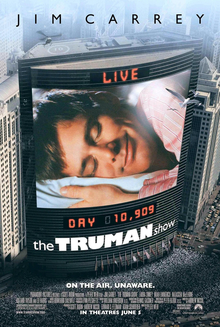
To an extent this book reminds me of a movie I once watched called The Truman Show. In this movie, Truman, played by Jim Carrey, lives in a world that is staged around him. Initially, Truman is unaware that he is living in a constructed reality T.V. show being broadcasted 24/7 around the world. As the movie progresses, Truman becomes suspicious of his perceived reality and embarks on a quest to discover the truth about his life. I find this to be similar to Allegiant because Tris also embarks on a quest to discover the truth about her life when she finds out that her world is not what she believed it to be. Tris describes the outside world like this, "The world beyond ours is full of roads and dark buildings and collapsing power lines. There is no life in it, as far as I can see; no movement, no sound but the wind and my own footsteps. It's like the landscape is an interrupted sentence, one side dangling in the air, unfinished, and the other, a completely different subject." Even though the two worlds portrayed in Allegiant and The Truman Show are two completely different scenarios, the concept is the same. And I am excited to see how the book ends!

To an extent this book reminds me of a movie I once watched called The Truman Show. In this movie, Truman, played by Jim Carrey, lives in a world that is staged around him. Initially, Truman is unaware that he is living in a constructed reality T.V. show being broadcasted 24/7 around the world. As the movie progresses, Truman becomes suspicious of his perceived reality and embarks on a quest to discover the truth about his life. I find this to be similar to Allegiant because Tris also embarks on a quest to discover the truth about her life when she finds out that her world is not what she believed it to be. Tris describes the outside world like this, "The world beyond ours is full of roads and dark buildings and collapsing power lines. There is no life in it, as far as I can see; no movement, no sound but the wind and my own footsteps. It's like the landscape is an interrupted sentence, one side dangling in the air, unfinished, and the other, a completely different subject." Even though the two worlds portrayed in Allegiant and The Truman Show are two completely different scenarios, the concept is the same. And I am excited to see how the book ends!
Monday, October 21, 2013
Article 1 Response: Is Google Making Us Stupid?
When reading this article about how the internet has changed the way we read, I found myself zoning off and having to reread sentences. The author, Nicholas Carr, states that before the luxury of the internet and other electronics, he spent his days reading long books or passages. He'd find himself deep in thought and sucked into the storyline. Research that once required days in the stacks of books at the library now require only a couple of minutes with a quick Google search at the tap of a finger. Nowadays, Carr finds himself spending a lot of time online and he noticed a difference in the way he reads. Instead of the long in-depth reading that once was, Carr will drift off in his thinking and become fidgety after a page or two of reading. He constantly finds himself dragging his brain back towards the text; the reading that use to come easily to him is now a struggle. Since I have always lived with the luxury of the Internet, I don't know what it is like to spend hours on end reading and researching a single topic from only books or article sources. I have always gone straight to the internet on my computer or phone when I had a simple question. You don't even need to know how to spell because the computer autocorrects misspelled words for you. Even though I haven't had the same history as Carr, I did have the same characteristics he described when reading. I thought Carr might have made the passage he wrote so long on purpose just to prove his point. I got bored and wanted to skip over sentences and paragraphs. I am drawn towards shorter articles and books that I think will be easier to read and critique. I think we live in a world that is constantly moving and in order to keep up we must live a fast-paced life.
The main point of the article was to show how media not only supplies but shapes the process of thought. Carr wanted to point out how internet has taken away the human concentration and contemplation and alters mental habits. It also carries on past the computer screen to TV programs, magazines, and newspaper. Carr said, "Once I was a scuba diver in the sea of words. Now I zip along the surface like a guy on a Jet Ski." I think that this is not only true for Carr, but also for me and many others who find themselves stuck in the internet world. I don't think this way of thinking will ever revert back to the way Carr remembered it. I believe our word is constantly changing and evolving and we can only move forward, or become more stupid, from here.

The main point of the article was to show how media not only supplies but shapes the process of thought. Carr wanted to point out how internet has taken away the human concentration and contemplation and alters mental habits. It also carries on past the computer screen to TV programs, magazines, and newspaper. Carr said, "Once I was a scuba diver in the sea of words. Now I zip along the surface like a guy on a Jet Ski." I think that this is not only true for Carr, but also for me and many others who find themselves stuck in the internet world. I don't think this way of thinking will ever revert back to the way Carr remembered it. I believe our word is constantly changing and evolving and we can only move forward, or become more stupid, from here.

Sunday, October 20, 2013
Reading Response #4: Opinion- Why We Make Bad Decisions
Since I am waiting for the third and final book of the Divergent series to be released, I googled interesting articles to find anything that sparked my interest. I found an article published by Noreena Hertz in New York Times. Hertz is a professor of economics at University College London and the author of “Eyes Wide Open: How to Make Smart Decisions in a Confusing World.” She wrote about the reasons human beings make poor decisions based on her own opinion, personal experience, and research in hopes that her readers may learn and hopefully make smarter decisions in their future.
The short article explains how she came across the topic of personal bias and common mistakes. Hertz became very ill and searched for an answer for her unexplained sickness. Seeing many professionals across the world, she got a lot of diagnoses and conflicting opinions from medical experts. She was not sure which was the right decision to choose and so she decided to research decision making in fields like neuroscience, psychology, sociology, information science, political science and history. To her surprise, Hertz found that physicians tend to get things wrong, yet most people never question experts. In her article she stated, "In a 2009 experiment carried out at Emory University, a group of adults were asked to make a decision while contemplating an expert’s claims, in this case, a financial expert. A functional M.R.I. scanner gauged their brain activity as they did so. The results were extraordinary: when confronted with the expert, it was as if the independent decision-making parts of many subjects’ brains pretty much switched off. They simply ceded their power to decide to the expert." Hertz then concluded that if we want to make the best possible decision in our favor we must turn our brains back on and come to medical consultations with plenty of background research done. We cannot let our personal biases get in the way of making an important decision either. Anxiety, stress, and fear are all emotions that can distort our choices. We must try to eliminate as much of our own flaws as others in the hope of coming to the right conclusion.
I really liked this article because it made me realize how nobody knows all of the answers. Even doctors make mistakes and it is up to us to decide who to trust, and ultimately, to make the final decision for ourselves. It reminds me a lot of a government website that advises you on making decisions and giving you helpful tips. The site is http://www.sba.gov/content/making-decisions. I'd advise you to check it out if you're having trouble with making the right choice. The article by Noreena Hertz is below.
http://www.nytimes.com/2013/10/20/opinion/sunday/why-we-make-bad-decisions.html?pagewanted=1&_r=0&src=me

Subscribe to:
Posts (Atom)